₹17,068.00 – ₹61,913.00Price range: ₹17,068.00 through ₹61,913.00
MasterOPC Universal Modbus Server is an OPC server for applications that communicate using the popular industrial protocol Modbus. The product supports the following Modbus modifications:
MasterOPC Universal Modbus OPC Server has the following distinctive features:
Available Variants:
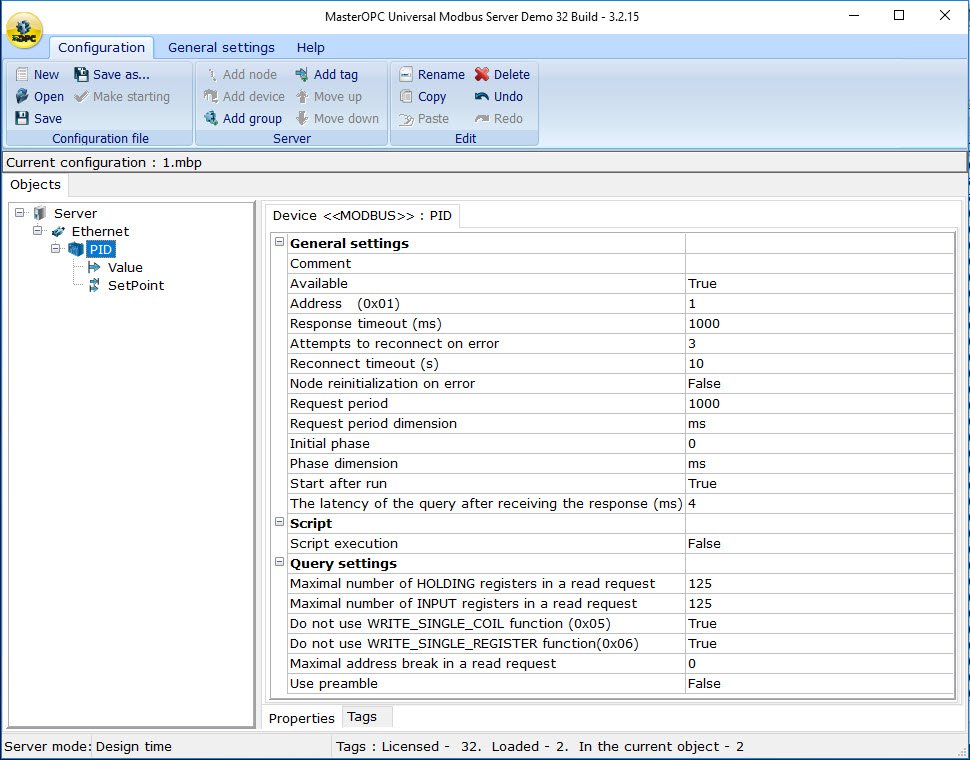
MasterOPC Universal Modbus Server is an OPC server for Modbus RTU/ASCII/TCP industrial applications. The Modbus OPC server provides two OPC interfaces: DA (Data Access, processed data) and HDA (Historical Data Access, archived data). To organize the storage of archived variables data MasterOPC uses the built-in SQL server.
The built-in programming editor (Lua Script) provides additional processing on data received from external devices as well as processing of data being sent to external devices. Processing variables via scripts using the built-in programming language is equaly essential for other important purposes. Using the scripting utility you can:
Scripts can be applied at any level in the OPC tree (communication nodes, devices, sub-devices or tags). The built-in editor provides other standard services such as keyword highlight, convenient work with tags or libraries, etc.
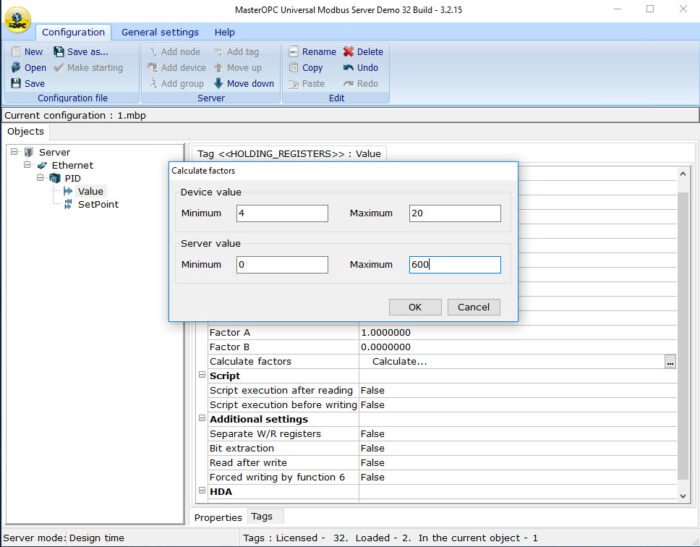
The server by default supports other typical operations on tags such as: automatic type casting, conversion to real measurement units, byte swapping, bit extraction, etc.
MasterOPC supports communication over GSM or other modem connections. This allows it to be used in supervisory control and/or data acquisition systems. MasterOPC can operate as well as a TCP server; this allows an effective use of MasterOPC together with 3G/4G/5G gateways without using static IP addressing mode. For diagnostic purposes, during run-time, MasterOPC logs and displays data transfer detailed events from driver or from script generators as user friendly messages and as Modbus protocol data units messages which help users of different qualification levels to track data transfer events.
Redundancy of communication channels
Redundancy allows you to create highly reliable connections with controllers and equipment.
Feature highlights:
MQTT protocol support.
MQTT protocol is designed for communication with IoT devices (Internet of Things Devices) and integration with cloud services (Microsoft Azure, Amazon Web Services, etc.). This functionality allows you to send and receive data from OPC servers in various cloud applications.
Feature highlights:
ODBC technology support.
ODBC technology provides integration with various DBMS (MS SQL, Oracle, MySQL, PostgreSQL, etc.). Built-in script editor exposes additional functionality to process data returned by an arbitrary SQL query. This makes integration of OPC server with applications that do not support OPC natively such as MES, ERP and BI systems a breeze.
Feature highlights:
IEC 60870-5-104 is an industry protocol mainly used in the Energy and Oil & Gas industries. Our OPC server supports IEC104 mode. This mode allows for an OPC server adapter from Modbus to IEC104 protocol while supporting other interfaces (OPC DA, UA, ODBC and MQTT).
Feature highlights:

Master OPC is a feature-rich, easy to use, and cost-effective OPC Software that supports multiple industrial protocols making it an excellent tool for System Integrators & end-users alike.
Copyrights ©2023 For Deutek Controls. All Rights Reserved..